
7 Best Banks for Students in 2026
The best banks for students in 2026, compared on overdraft policy, ATM access, monthly fees and what happens when student status ends.
By Michael Hewitt, Founder & Editor-in-Chief. Updated September 24, 2026.
Students lose real money to avoidable fees: out-of-network ATM surcharges, overdraft charges on a $10 coffee run, and monthly maintenance fees that a student account would have waived. The differences between student checking accounts rarely show up in the marketing copy. They show up in the fine print governing overdraft structure, ATM reimbursement caps, and whether a linked savings account actually pays a competitive APY or just advertises one. Before opening a first independent account, it helps to understand three terms that separate a good student account from an expensive one: APY (annual percentage yield, the actual rate of return including compounding), overdraft grace period (a window to cover a negative balance before a fee posts), and fee-free ATM network (a list of machines, often Allpoint or MoneyPass, where withdrawals cost nothing). The seven accounts below are ranked by use case, not by sign-up bonus size, because the account that fits a commuter student in a small town looks nothing like the one that fits a student living near a downtown branch network.
1. SoFi Checking and Savings
SoFi's combo account works because it removes the friction between spending and saving. Checking and savings live under one login, and unused balances can route automatically into savings "vaults" earmarked for specific goals (textbooks, spring break, a laptop repair fund) without a manual transfer.
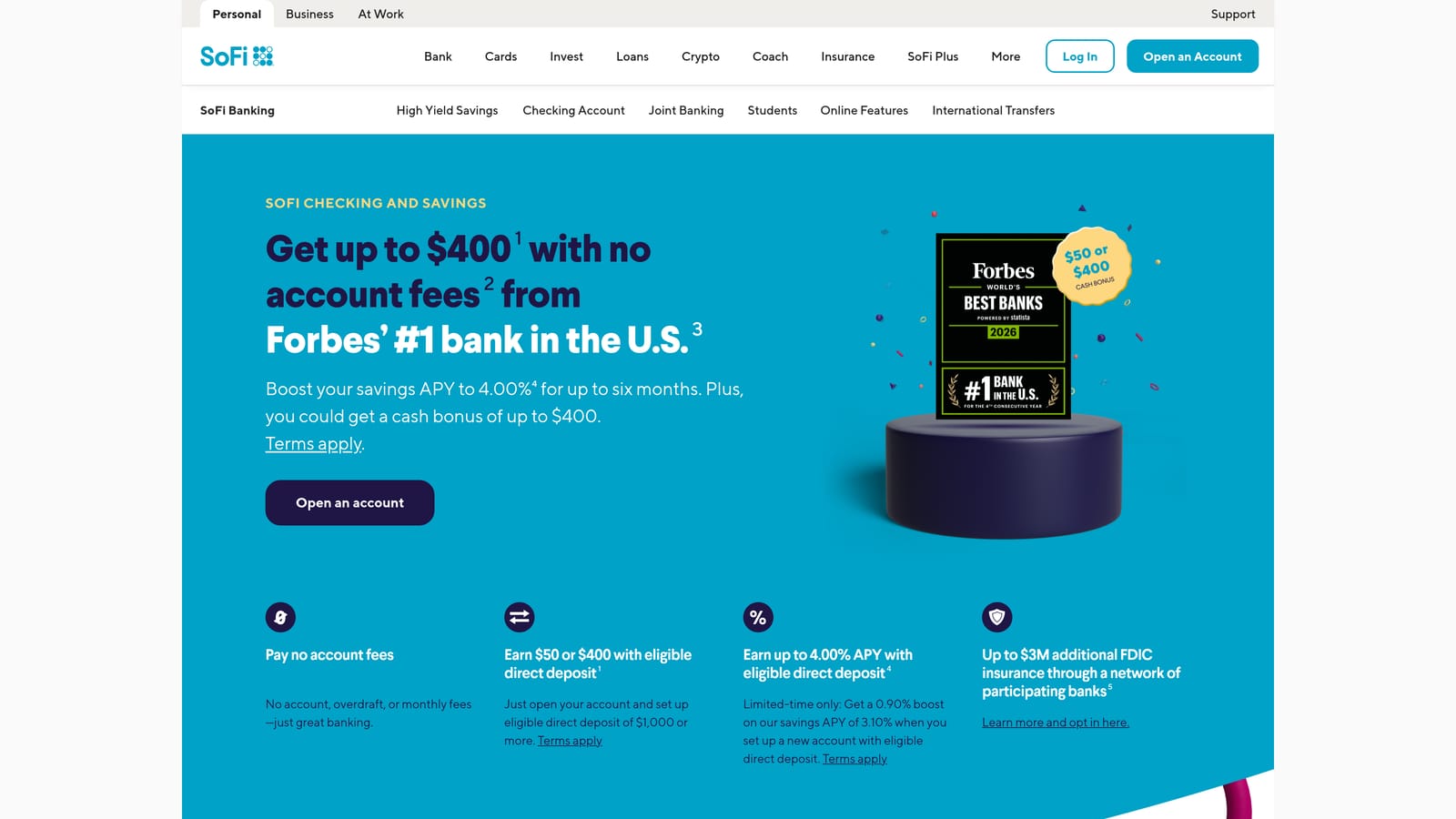
Consider a student receiving biweekly work-study paychecks by direct deposit. SoFi posts many direct deposits up to two days before the stated pay date, and the savings side has historically paid a meaningfully higher APY than a typical big-bank savings account once the qualifying deposit threshold is met.
- Apply online; there is no monthly fee and no minimum balance requirement.
- Set up direct deposit of at least the qualifying minimum, since this is what unlocks the higher savings APY tier rather than the base rate.
- Create one or more savings vaults tied to specific expenses and automate transfers into them.
The common mistake is opening the account expecting the advertised APY to apply automatically. Many students never route a qualifying direct deposit into the account and end up earning the lower base rate indefinitely. Check the SoFi Checking and Savings review for current qualifying deposit thresholds, since SoFi has adjusted these terms before. To confirm the strategy is working, verify the APY posted on the monthly statement matches the qualifying tier, and confirm direct deposits are actually landing two days early.
Read our review of Bread Savings High-Yield Savings. Best for: Savings + CD ladder combos. Disclosures
2. Capital One 360 Checking
Capital One 360 Checking is built for students who move between cities or need nationwide access without paying monthly maintenance fees. It charges no monthly fee, requires no minimum opening deposit, and connects to a large fee-free ATM network alongside physical Capital One Cafe locations in select cities.
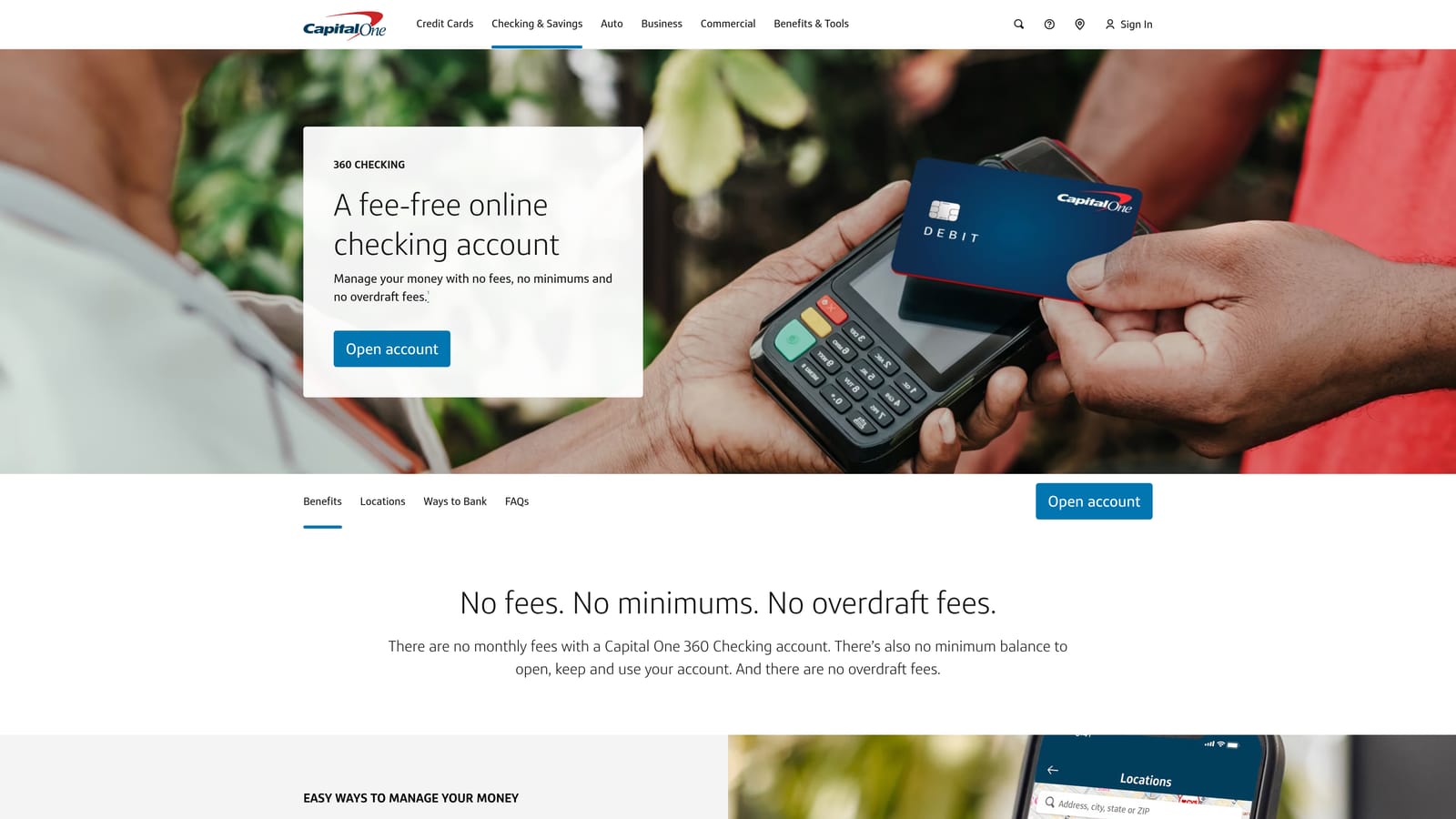
A student attending school in a city with a Capital One Cafe can deposit a financial aid refund check in person and use the cafe's free wifi to study while banking. That combination of branch-like service without a traditional branch network is unusual among fee-free accounts.
- Open the account online; no minimum deposit is required.
- Link the debit card to the Capital One mobile app and enable real-time balance and transaction alerts.
- Locate the nearest Allpoint-network ATM before relying on the account for regular cash withdrawals.
The recurring mistake is using an out-of-network ATM for convenience and eating a third-party surcharge that Capital One does not reimburse, unlike some competitors on this list. Students should track monthly ATM fees; a well-managed account should show zero every month. Details on cafe locations and current ATM network size are in the Capital One 360 Checking review.
3. Ally Bank Interest Checking
Ally Interest Checking pays interest on a checking balance, charges no overdraft fees, and reimburses up to $10 a month in out-of-network ATM fees on top of 43,000+ fee-free Allpoint ATMs. The rate is tiered: 0.10% APY under $15,000 and 0.25% at $15,000 or more.
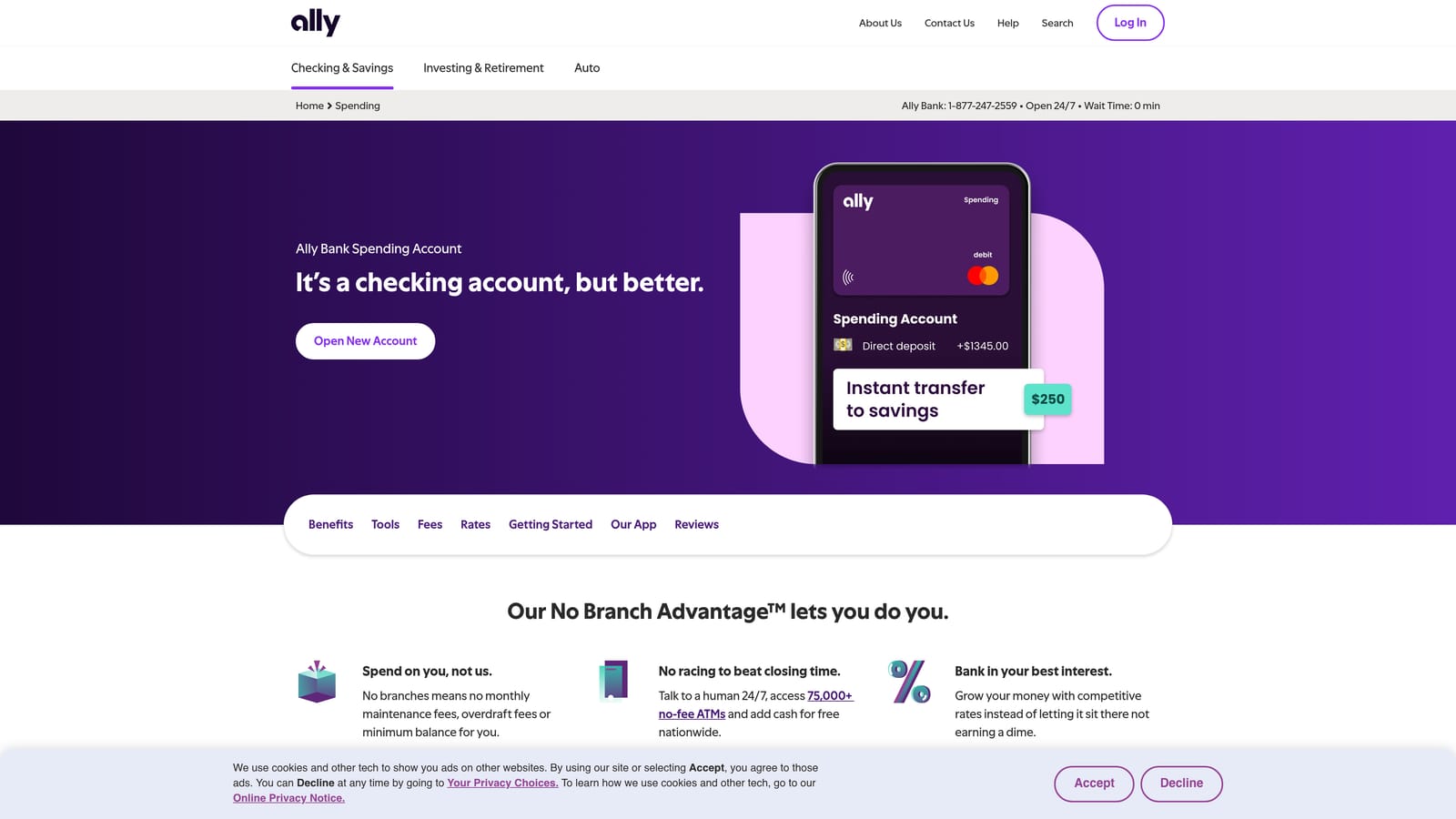
Take a student who banks a $5,000 buffer from a summer internship. At 0.10% APY that earns about $5 a year, so the reason to keep spending money here is access, not interest: the Allpoint network and the monthly reimbursement cover most cash withdrawals.
- Open the account online; Ally is a branchless, FDIC-insured bank.
- Link an Ally savings account to enable fee-free overdraft transfer coverage.
- Move cash beyond a month or two of spending into a high-yield savings account, where it earns far more.
The most common error is skipping the linked savings account. Without it, the account forfeits Ally's overdraft transfer protection, and transactions can be declined outright when the balance runs short. Current rates and ATM terms are in the Ally Bank Interest Checking review.
4. Chase College Checking
Chase College Checking suits students who want branch access and are comfortable with a fee that requires active management to avoid. Chase waives the monthly fee for enrolled students, and it periodically offers a cash bonus for new accounts that meet a qualifying direct deposit within a set window; students should confirm the current offer before applying, since Chase adjusts bonus terms regularly.
A student who meets the offer's direct-deposit requirement can capture that bonus while also gaining access to Chase's nationwide branch and ATM network near many campuses, useful for students who prefer face-to-face banking over an app-only relationship.
- Open the account in-branch or online.
- Submit proof of student enrollment to trigger the monthly fee waiver.
- Set up qualifying direct deposit before the bonus deadline stated in the current offer terms.
The mistake students make most often is losing track of when the student waiver ends. After that, the standard monthly fee applies unless another waiver condition is met. Check monthly statements for the fee-waiver code and confirm any bonus posts within the timeframe specified.
5. Axos Bank First Checking
Axos First Checking is a custodial-style account designed for ages 13 to 17, opened jointly with a parent, and it charges no monthly fees while reimbursing domestic ATM fees. It functions as a teenager's first bank account with built-in parental oversight rather than a full-autonomy product.
Imagine a parent who can see every school-lunch purchase on a teenager's debit card because the account is held jointly. That visibility lets a parent teach budgeting without micromanaging every purchase in person.
- Open the account jointly as parent and teen through Axos's online application.
- Set up transaction alerts in the mobile app.
- Plan ahead for the transition to a standard Axos checking product once the teen turns 18, since First Checking is not a permanent account.
The pitfall here is neglecting to review the new account terms at that age-out transition. Families who skip this step can find fees or lose ATM reimbursement without realizing the product changed underneath them. Monitor whether ATM fees are reimbursed correctly each month.
6. Fifth Third Momentum Checking
Fifth Third Momentum Checking works best as a regional pick, not a nationwide default. It carries no monthly service fee and includes an overdraft grace window: a deposit made before the bank's stated cutoff avoids the overdraft fee entirely. Its value depends heavily on whether the student attends school inside Fifth Third's Midwest and Southeast branch footprint.
A student at a Midwest university overdraws by $20 buying textbooks but deposits birthday money before the cutoff, avoiding the fee altogether. That grace window functions as a built-in safety net that many online-only accounts don't offer.
- Confirm a nearby branch or ATM exists before opening the account.
- Set low-balance alerts to catch shortfalls before the grace window closes.
The recurring error is opening this account while attending school outside Fifth Third's service area, leaving the student without practical branch or ATM access when they need it most. Track how often the overdraft grace period gets used and whether fees are successfully avoided within the window.
7. Bank of America Advantage SafeBalance
Advantage SafeBalance takes a different approach to overdrafts entirely: instead of allowing a transaction to overdraw the account and charging a fee, the account simply declines the transaction. That structural choice eliminates overdraft fees rather than waiving or capping them, and Bank of America waives the monthly fee for students under 25, subject to current terms.

Picture a student whose debit card is declined at checkout for insufficient funds rather than approved with an overdraft fee attached, the outcome many traditional checking accounts still produce. The inconvenience of a declined card is minor compared to the cascading fees a standard account can generate in a single bad week.
- Open the account and submit proof of enrollment and age to secure the student fee waiver.
- Rely on mobile alerts for balance monitoring, since the account does not support paper checks.
- Note when the student waiver ends; it applies only while the owner is a student under 25.
The common mistake is assuming this functions like a standard checking account with check-writing capability. Students who need to pay a landlord or a subletter by paper check will need a separate solution alongside this account. Confirm zero overdraft fees appear on statements and verify the monthly fee is being waived.
Read our review of NBKC Everything Account. Best for: Simplicity seekers who want real APY. Disclosures
Matching the Account to the Student, Not the Bonus
Students without an existing bank relationship should start with a no-fee, nationwide option: Capital One 360 Checking or SoFi Checking and Savings both remove the geography problem and charge nothing to maintain a balance. From there, layer in a specialized account only if spending habits or location justify it. A student near a Chase or Fifth Third branch with a real need for in-person service may find the trade-off of a conditional fee waiver worthwhile. Parents opening a first account for a teenager should start with Axos First Checking specifically because a parent holds it jointly and sees every transaction, then plan the transition at 18 rather than treating it as permanent.
All seven banks listed here are FDIC-insured up to $250,000 per depositor, per institution, per ownership category, so the decision comes down to fee structure and access, not deposit safety. Confirm current APY tiers, bonus terms and fee waivers with the bank before you open. Compare checking accounts side by side before you commit a first paycheck to any single bank.